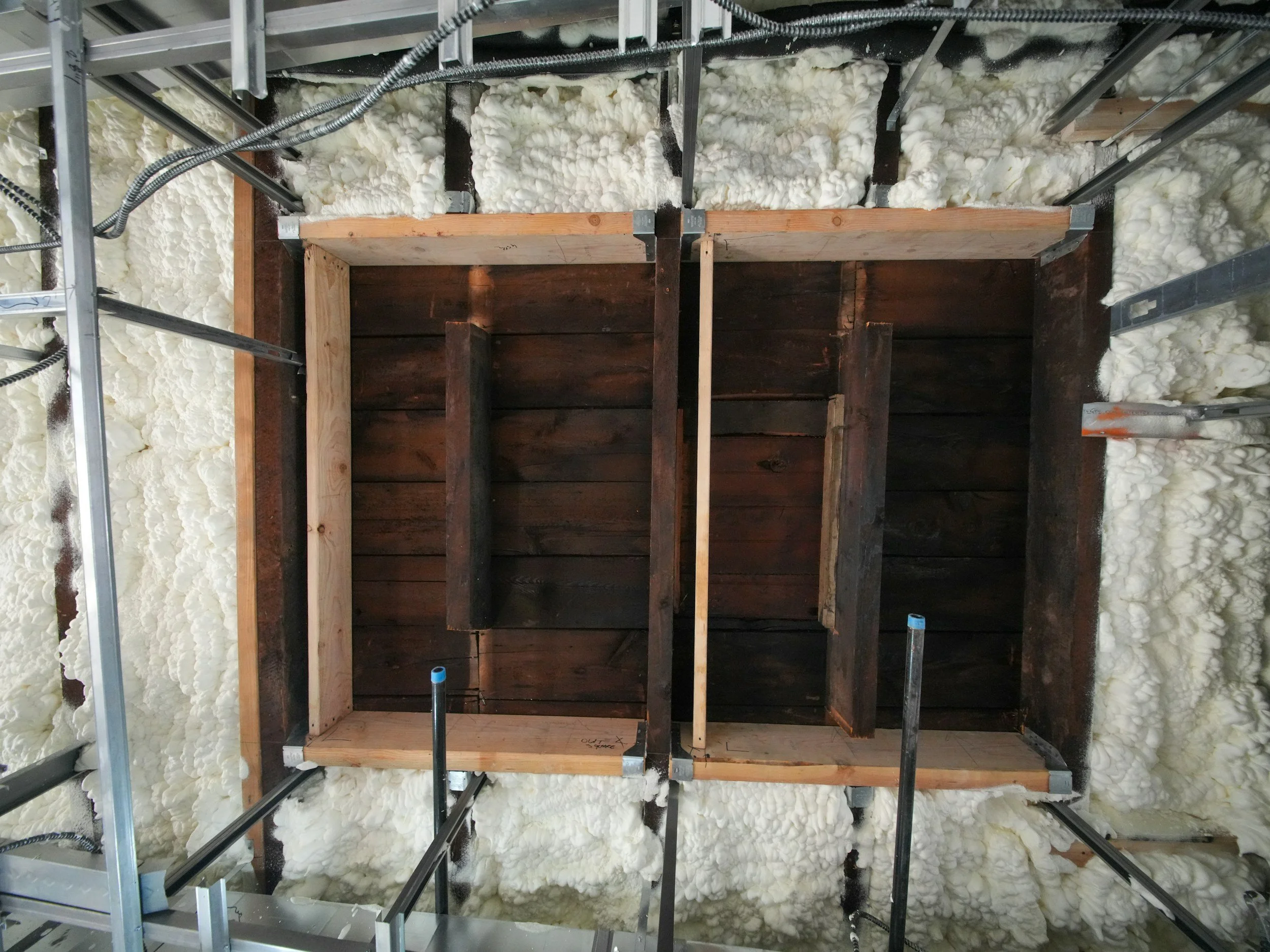
TLDR: Yes, in the places where nothing else does the job: sloped roofs and cathedral ceilings, the underside of a cantilevered floor, beam and joist pockets, and the ducts that run through a cold attic. No, as the default for the whole house. On our current Toronto additions, Rockwool batts with a vapour barrier price at $4.00 to $5.00 per square foot of exterior wall. Spray foam on those same walls costs more to buy and more to install. Spray foam in a roof slope runs $9.60 to $10.30. And spray foam against a double brick wall is the one place we tell families no, because the wall needs to breathe. Everywhere else is fine, but you will be paying a premium.
What most homeowners get wrong: "spray foam everywhere"
Here is the request we hear a few times a year: spray foam everything, so the house is airtight. The logic is sound as far as it goes. Spray foam is an insulation and a vapour barrier in one product. It creates a really airtight assembly and prevents air leakage, usually better than batt insulation plus a separate vapour barrier.
Two things get missed.
The first is the installer. The air leakage difference comes down to the installers mostly. A batt and vapour barrier assembly that is installed properly, with the poly sealed at every penetration and the batts cut to fit rather than stuffed, can be very airtight as well. Spray foam covers for a careless crew. A careful crew gets there with batts.
The second is the house you already own. A home addition is built onto an existing structure, and that structure likely already has a lot of air leakage through the existing levels and assemblies. Paying a premium to make the new 1,000 square feet airtight while the original 1,500 square feet leaks the way it always has does not buy what the brochure says it buys.
Where spray foam earns its cost
Spray foam is normally used in the areas that are harder to complete any other way. On an addition that means four places.
Beam and joist pockets. Where a steel beam or the floor joists meet the exterior wall, the cavities are small, irregular and full of hardware. Batts cannot be cut to fit them and poly cannot be sealed around them. Spray foam fills the pocket and seals it in one pass. On our North York additions this line runs $7.50 per square foot at R-31, and a typical addition has a few hundred square feet of it.
Cantilevered floors. Cantilevered floor assemblies are popular in Toronto additions, and the underside of that floor is exposed to outside air. Spray foam is the standard answer there, and we have written about the cantilevered floor system before. On our Guildwood and North York additions the exposed floor and rim board sit in the same R-31 line as the joist pockets.
Sloped roofs and cathedral ceilings. A ceiling finished to the underside of the rafters has no attic above it, so the rafter bay has to carry the whole roof’s insulation. That is where closed-cell spray foam goes, and it is the most expensive line in the insulation budget: $10.28 per square foot on a North York slanted ceiling and knee wall, $9.61 on a garage ceiling in Guildwood. Both are R-36.
Ducts in unconditioned space. On a second-storey addition we often run the supply and return ducting through the attic, because that is how you heat the new rooms without bulkheads in the old ones. That attic is cold, so the ducts get sprayed. Our budgets carry it as a Building Code item rather than an upgrade, and it runs $3,500 to $4,000 as a lump on our current North York and Guildwood additions.
Where Rockwool does the job better
Exterior walls. Batt insulation, specifically Rockwool, is what we use for exterior wall assemblies on almost every addition. It costs less to buy and less to install than spray foam.
A 2x6 wall takes an R-22 Rockwool batt with a vapour barrier over it. Installed properly, that wall performs. On our current additions the Rockwool wall line prices at $4.00 per square foot in Guildwood, $4.38 in North York and East York, and $5.00 on a North York second storey.
Rockwool also has a second job on most of our projects: sound. Rockwool Safe’n’Sound goes into the joist cavities between floors and the walls between bedrooms, at $4 to $5 per square foot.
The numbers, from our own budgets
These are client prices from the budgets of BVM additions that are built or under construction, pulled in October 2026. They are what the homeowner pays, not what the material costs us. Estimates and unsigned proposals are left out.
2x6 exterior wall, R-22, Rockwool batt + vapour barrier: $4.00 to $5.00
Joist pockets, rim board, cantilevered floor, R-31, Closed-cell spray foam: $7.50
Sloped roof, cathedral ceiling, garage ceiling, R-36, Closed-cell spray foam: $9.60 to $10.30
Joist cavities between floors, R-12 flash, Closed-cell spray foam: $3.70 to $4.00
Ducts in the attic, R-12, Closed-cell spray foam: $3,500 to $4,000 per job
On the walls, spray foam is a premium product at a premium price for an assembly that a good crew makes airtight with batts anyway. On 1,000 square feet of exterior wall, which is a normal second-storey addition, that premium adds up.
What a real hybrid looks like: our Guildwood addition carries $10,848 of Rockwool on 2,712 square feet of wall, and $6,813 of spray foam across the garage ceiling, the joist cavities and the attic ducts. A North York second storey with a long slanted ceiling flips it: $5,175 of Rockwool on the walls and $9,748 of spray foam, because the roof slope alone is 500 square feet of R-36. The roof shape sets the spray foam bill.
Where it goes wrong: spray foam on double brick
Much of Toronto’s older housing stock, from the Beaches to Bloor West, is double brick. Spray foam is not the best option against double brick wall assemblies because it does not provide the necessary amount of breathability that a double brick wall needs to properly function. Seal the inside face of that wall with foam and you have taken away the one thing it relies on. That is the one place in a house where "spray foam everywhere" does harm rather than just costing more.
So when we are recommending insulation for a project and a client is adamant about spray foam, we only focus on the areas where the spray foam will not negatively affect the assembly. The new framed walls of the addition, yes if they want to pay for it. The original masonry walls of the house, no.
The BVM approach: a hybrid, by assembly
We mostly do a hybrid between Rockwool and spray foam on our projects, to balance cost effectiveness with performance. The split is decided assembly by assembly on the drawings, before the budget goes to the client: Rockwool with a vapour barrier in every framed exterior wall, spray foam in the four places above, Rockwool Safe’n’Sound between floors and between bedrooms. Where the drawings call for continuous insulation on the outside of the wall, rigid foam board goes under the cladding, which is a separate line and a separate article.
The honest downside of our recommendation is that it puts more weight on the installer than the all-foam version does. "Installed properly" is our responsibility on site. A family that wants the product to carry that risk instead of the crew is making a reasonable choice, and some clients do want everything in spray foam to get a really airtight finish. On the new framed assemblies we will build it that way, and the budget will show the premium line by line.
What to ask any builder about insulation, and what a bad answer sounds like
Ask for the insulation lines in the budget by assembly: walls, roof, floors, ducts. A real budget has them split out with a product, an R-value and a square footage against each one.
A bad answer is "spray foam throughout" as a single line with a single price. It usually means the builder has not looked at the roof shape, has not asked whether the existing house is masonry, and is pricing a premium product by the house rather than by the assembly. The opposite is just as bad: a low "insulation allowance" with no product named, which is the batt price for everything, including the roof slope where batts cannot do the job.
Ask what goes against the original brick. If the answer is spray foam, ask how the wall is supposed to breathe.
Ask who installs the vapour barrier and who checks it before drywall. The answer tells you whether the builder understands that the batt assembly comes down to the installer.
Key takeaways
Spray foam is worth it in sloped roofs, cathedral ceilings, cantilevered floors, beam and joist pockets, and attic ducts. Those are hard to insulate any other way and the budget lines are $7.50 to $10.30 per square foot.
Rockwool batts with a vapour barrier handle the exterior walls at $4.00 to $5.00 per square foot on our current Toronto additions. Spray foam on the same walls costs more to buy and more to install.
A properly installed batt and poly assembly is very airtight. The difference comes down to the installers mostly.
Your addition is attached to an existing house that already leaks air. Airtightness in the new part only matters in proportion to the old part.
Never spray foam the inside of a double brick wall. It needs to breathe, and foam stops it.
The roof shape sets most of the spray foam bill. A long slanted ceiling can put more money into foam than into every wall combined.
Frequently asked questions
Is spray foam worth it for exterior walls on a Toronto addition?
Usually not. Rockwool batts with a sealed vapour barrier price at $4.00 to $5.00 per square foot on our current additions and make an airtight wall when installed properly. Spray foam on the same wall costs more. It is a reasonable upgrade if you want the product rather than the crew to carry the airtightness, and you pay the premium for it.
Can you spray foam the walls of an old Toronto brick house?
Not the inside face of a double brick wall. That wall dries to the inside, and closed-cell foam stops it. We limit spray foam to the new framed assemblies and the roof, floor and duct locations where it earns its cost.
How much does spray foam insulation cost per square foot in Toronto?
On our live addition budgets, closed-cell spray foam prices at $7.50 per square foot in joist pockets and exposed floors at R-31 and $9.60 to $10.30 in sloped roofs and ceilings at R-36. Attic ductwork runs $3,500 to $4,000 as a lump.
Get the insulation split before you get the drawings
We price insulation by assembly before a family commits to a design, because the roof shape they fall in love with is also the spray foam bill they will pay. The Home Addition Feasibility Report gives you the zoning, the budget and the timeline for your property first. Or book a free 30-minute discovery call and ask us where the foam goes on your house.
Book your 30-minute discovery call